
Gut Skin Axis – Anti-Aging Red Light Therapies And More
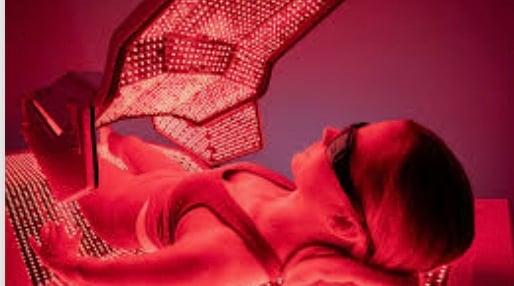
Have you heard of red light therapy for skin? Have you seen the new red light face masks? Red light therapy is becoming a popular option for skin anti-aging, but does it really work?
We’ll answer all these important questions and others on red light therapy in this blog.
See our recent blogs on skin health (the gut-skin axis, skin aging, skin care ingredients, supplements for skin aging, psoriasis, psoriasis treatment, rosacea, eczema, acne, and athlete’s foot .
In this blog on anti-aging and light therapy, you will learn:
- What are the different types of light therapy for skin health?
- What are the benefits of light therapy?
- Does red light therapy really work for anti-aging?
What is Light Therapy?
Light therapy has different names. It can be called Low-Level Laser Therapy (LLLT), photobiomodulation or light therapy. Light therapy uses light emitting diodes (LEDs) in a specific wavelength, measured in nanometers (nm). The wavelength tells us how deep into the skin and body the light penetrates. Shorter wavelengths, like blue light (415 nm) stay on the skin’s surface. Longer wavelengths, such as red light (630–700 nm), penetrate deeper into the skin. Near-infrared light has an even longer wavelength (>700 nm) and goes the deepest.
Light therapy has multiple health benefits. It can be used to lessen and even reverse visible signs of skin aging. See our blog from 2019 for details on the benefits of light therapy.
For dermatological purposes, blue light (400–470 nm wavelength), yellow light (570–590 nm wavelength), red light (630–760 nm wavelength) and near-infrared light (760–1200 nm wavelength) are used (Guo Z, 2025).
In this blog, we will focus on red light which is the best for anti-aging. Blue light better addresses acne and yellow light reduces redness. Near-infrared light can address muscle, joint and deep tissue issues.
Red light (630–700 nm) has a relatively deep tissue penetration that can reach the entire dermis (Guo Z, 2025). The dermis is the middle layer of skin, between the surface epidermis and the deeper subcutaneous tissue. The dermis provides strength, flexibility and elasticity to the skin through a network of collagen and elastin fibers. It provides structural support to skin.
How does Light Therapy Work?
What is the mechanism of action of light therapy? The light particles of light therapy penetrate the skin and are absorbed by cells, primarily in the mitochondria. Light therapy strengthens cells and the mitochondria. All cells in the body have mitochondria. Mitochondria are commonly called the powerhouses of the cells. They provide the energy release or ATP (adenosine triphosphate) for the cell. ATP gives the cell energy for cellular processes like muscle contraction, nerve impulses, the synthesis of new molecules and injury repair.
The light from light therapy is absorbed in the mitochondria of cells, increasing the mitochondria’s potential. This increases ATP production and cellular signaling and reduces oxidative stress. Cells absorb the light to increase ATP, RNA and protein synthesis, oxygen consumption and cellular communication (Couturaud V, 2023).
What are the Benefits of Light Therapy?
When a cell is damaged, mitochondrial function is impaired so less ATP is made. Less ATP decreases the cell’s healing time. With more ATP and more energy from light therapy, cells can function more efficiently, rejuvenate themselves and repair damage. This promotes cellular repair and regeneration and reduces inflammation.
The many benefits of light therapy for skin include (Guo Z, 2025):
- Light therapy stimulates collagen production by delivering specific wavelengths of light deep into the skin. This increases collagen and elastin, which support the dermis and skin structure.
- Light therapy increases circulation to improve complexion.
- It increases cellular regeneration and protects cells from oxidative stress damage.
- Light therapy promotes wound healing and tissue repair.
- Light therapy can treat acne, decrease scars and inflammation and rejuvenate skin.
Other types of light therapy can also benefit skin. Blue light improves acne and helps repair the skin barrier with its antibacterial effects. Yellow light helps reduce surface wounds and redness. Near-infrared light helps with pigmentation, skin aging and wound healing. Combining different light wavelengths increases the benefits for acne, aging and wound repair (Guo Z, 2025).
How does Light Therapy Affect Skin Aging?
Using red light in the (600–700 nm) range maximizes the benefits. It can effectively reverse the signs of facial skin aging, by improving skin texture, reducing wrinkles and increasing skin elasticity (Guo Z, 2025).
- Red light therapy smooths and plumps the skin, which reduces the appearance of fine lines and wrinkles.
- It builds collagen and elastin to help reduce wrinkles and tighten the skin. This improves skin firmness and elasticity.
- By increasing collagen levels, consistent light therapy can improve skin texture and make skin firmer, smoother and more youthful-looking.
- Red light can reduce age and dark spots.
- It improves overall skin texture and complexion.
One study looked at a specific face mask using a red light wavelength of 630 (Couturaud V, 2023). Study participants used the face mask at home for 12-minute sessions, twice a week, for 3 months. The sessions were spaced 72 hours apart.
After 1 month, the following skin improvements were noticed (Couturaud V, 2023):
- A 15.6% decrease in the depth of crow’s feet wrinkles.
- A 5.4% decrease in slackening of skin and a 13.6% more firming effect.
- A 26.4% increase in dermal density, the skin’s middle layer, which is made up of collagen and elastin. Skin density decreases with age, as do skin firmness and volume.
- A 6.8% decrease in cheek roughness and a 28.5% decrease in pore diameter, which makes skin appear smoother.
- A 34.9% decrease in the quantity of sebum, or oil, that can lead to acne breakouts.
To Read About Blog Topic, Scroll Down
Want To Work With Our Clinic?
Do you have a chronic or mystery illness that no one has been able to help you with? Are you simply wanting to re-connect with a healthier version of yourself? It’s Time To Finally Feel Better!
After 2 months of use, skin elasticity increased 12.5% and skin tone homogeneity increased 32.7% (Couturaud V, 2023).
After 3 months of use, there were further improvements in all of the above-mentioned parameters (Couturaud V, 2023).
Red light therapy also promotes hair growth. It improves androgenic alopecia in both men and women. Androgenic alopecia is male or female pattern baldness, caused by a genetic predisposition and the effect of androgens on hair follicles.
Red light can increase hair count, density and diameter. It is thought to promote hair growth by activating a mitochondrial signaling pathway, which improves hair count and hair follicle density. This improves male/female pattern baldness or androgenic alopecia (Guo Z, 2025).
Near Infra-Red Light Therapy or NIR
NIR light of 800 nm benefits skin aging, cellular activity, wound healing and hair growth (Guo Z, 2025). It penetrates deeper and has more profound effects on skin elasticity and deep wrinkles. NIR goes deeper into the dermis and tissues, making it ideal for deeper wrinkles, scars and tissue repair.
Combining Different Types of Light Therapy
Combining multiple wavelengths of light can give better results. A combination of red light and near-infrared light (640 nm + 800 nm) increases type I collagen and elastin fiber and activates collagen synthesis (Guo Z, 2025). Most light therapy masks and devices use both red light for superficial issues and NIR for more depth.
Combining red light with blue light can improve acne treatment. In research, red + blue light therapy improves inflammatory lesions by 24.4% and non-inflammatory lesions by 19.5% (Guo Z, 2025). Daily at home use of red + blue light therapy for 4 weeks significantly reduces inflammatory and non-inflammatory acne lesions by 77% and 54%, respectively. It also reduces sebaceous secretion and decreased sebaceous gland size (Guo Z, 2025).
How to Use Red Light Therapy?
Red light therapy can be done professionally at a dermatologist’s office or in some spas. Professional treatments are higher intensity.
Red light therapy can also be done at home. There are now many increasingly popular red light face masks on the market. These can be used at home for similar effects, although they will be less intense than professional light therapy sessions. The FDA has approved and cleared some at home masks for safety. This means they are safe to use but does not necessarily guarantee results.
Consistency is important with light therapy. Results are not immediate. It can take several weeks of consistent use to start to see skin improvements. Once improvements have been achieved, maintenance is important. Red light therapy needs to be a regular practice to maintain and continue the improvements.
Daily sessions of light therapy are not advised. Once the cells have been activated with light therapy, a few days are needed for best results. With red light therapy both too little and too much can be ineffective. Research shows 72 hours between sessions may be the ideal time (Couturaud V, 2023).
Red light therapy and retinol should not be combined. Use red light therapy in the morning, for example, and retinol at night. Or use them on different days.
As with any new therapy, start low and slow. Start with a short period of time a couple of times per week and go from there. Always follow your practitioner’s advice or the face mask manufacturer’s guidelines for session length and frequency. And be sure to continue to use sunscreen to protect skin.
Light therapy is a non-invasive treatment that has subtle but noticeable improvements, especially for moderate wrinkles. Results are often gradual and require consistent use over several weeks with ongoing maintenance.
If you are interested in optimizing your skin health to age well or need help with other skin issues then get in touch with us at the Medicine with Heart clinic. We can help you to best manage and optimize your skin health!
Are You Suffering From A Chronic Illness?
Does your current health situation look like this…
- Do you feel that you have tried many things and either nothing works, or the treatment does not hold?
- Have you been told that there is nothing that can be done to reverse your illness and you just need to manage symptoms?
- Does your illness impact your work, your family, your happiness and your social life?
We specialize in finding answers and solutions for complicated chronic illness when people feel like they have tried everything. If this sounds like you, book a free call with us to see if we are the right fit for your health goals.